Erin MacGregor

2026

Erin MacGregor

2026

Erin MacGregor

2026

Erin MacGregor

2026

Dall-E and Me:
Dall-E and Me:
Dall-E and Me:

AN AI DESIGN THEORY

AN AI DESIGN THEORY

DELIVERABLES

DELIVERABLES

DELIVERABLES

WEB APP, THESIS

WEB APP, THESIS

STUDIO

STUDIO

OCAD UNIVERSITY

OCAD UNIVERSITY

ROLE

DESIGNER

DESIGNER

SERVICE

SERVICE

SERVICE

UI/UX, RESEARCH

UI/UX, RESEARCH

Overview

Overview

OUR CRAFT MOVING FORWARD IS UNCERTAIN AND FULL OF NEW CHALLENGES. I TOOK ON THIS PROJECT FOR YOUNG DESIGNERS NAVIGATING THE NEW ENVIRONMENT OF DESIGN - ONE THAT USES AI.

This project is part design methodology, part philosophy paper, and part UX concept. In my final year at OCAD University, I investigated how designers can work effectively with AI image generation tools, developing an original prompting framework I called component prompting.


The research involved stakeholder analysis, a two-session workshop with creative participants, and culminated in a UI concept called Chemist, a visual interface for AI prompting. The project was awarded the Nora E. Vaughn Best Student Work Medal for my graduating year, and some of its ideas have since been incorporated into OCAD's curriculum.

Research Phase

My thesis prof needed me to develop an accurate framework of users and personas in order for me to proceed with this thesis. My topic was regarded as unusual and divisive, so the case study absolutely had to be there. During this phase, I created a prompting clinic to study how my peers used AI (Dall-E 2 in this case, my how we've already advanced!)

My dual prompting clinics were how I created my user needs frameworks, and personas.

My thesis prof needed me to develop an accurate framework of users and personas in order for me to proceed with this thesis. My topic was regarded as unusual and divisive, so the case study absolutely had to be there. During this phase, I created a prompting clinic to study how my peers used AI (Dall-E 2 in this case, my how we've already advanced!)

My dual prompting clinics were how I created my user needs frameworks, and personas.

My thesis prof needed me to develop an accurate framework of users and personas in order for me to proceed with this project. My topic was regarded as unusual and divisive, so the case study absolutely had to be there. During this phase, I created a prompting clinic to study how my peers used AI (Dall-E 2 in this case, my how we've already advanced!)

My dual prompting clinics were how I created my user needs frameworks, and personas.

  • PERSONA 1 - THE PAINTER

    a close up of a painting with a brush

    I am the Painter. I do not primarily think in words, as visuals are where my interest lies. Sometimes it is hard to put what I am looking for into words. The worst part of my process is when I am forced to overwork my ideas in the ideation phase. I wish I could just flow.

    In comparison, the Painters prompts were quite short. They primarily used the AI to ideate new concepts. For example, the painter gave me the simplest prompt, “Landscape of Hell”. When they saw that the AI gave them back something without fire and brimstone, they were delighted.

    Ultimately, The Painter has a need for new sources of inspiration, previously unseen by the world. Their creativity is highly exploratory.


  • PERSONA 2 - THE WRITER

    A close up of an old fashioned typewriter

    I am the Writer. I am pensive, and meditative. I spend countless hours playing with words and obsess over their interplay. The best part of my process is when inspiration hits, and I know in my soul it is perfect.

    The Writer gave me the longest prompts. They really struggled to simplify their ideas. This is obviously because their craft is wordsmithing, so every word is important to them. When working with AI, the Writer has a need to be able to focus on the most important parts of prompting.

  • PERSONA 3- THE DESIGNERS

    silver and black digital wall clock

    We are the designers. We are a collective, constantly under the flux and pull of each other’s ideas. Our process is very structured, compared to other creatives. Sometimes, the sheer volume of ideas we generate cannot get the right amount of attention they deserve.

    What I am about to say will surprise no one. Designers, are a MESS. They cling to anything that will give them some kind of structure in their process, whether it’s to-do lists or personal assistants. This reflects on a need to be able to quickly and accurately narrow down the best ideas for design briefs because we are constantly under a time crunch.


  • PERSONA 4- THE CHEF

    a blue plate with a small piece of food on it

    I am the Chef. My profession teeters on the knife’s edge between perfection and performability. I am constantly under pressure to outdo myself with every deadline. If I have a creative block, I have to work very hard to fight my way out of it. My medium is known to all, but practiced by few. This is my dilemma.

    Like The Painter, The Chef has a need for novel ideas and generative power. And something very strange happened during this interview. When The Chef was tired of prompting simple dish names, they started typing in recipe ingredients...

    This is how I refined my hypothesis.


Empty outdoor cafe seating at dusk

A Unique Observation

I INTERVIEWED A ROBUST VARIETY OF CREATIVES, FROM DIFFERENT DISCIPLINES IN ORDER TO GLEAN HOW WE ALL LEVERAGE AI.

One of my more eclectic choices for interviews was with a well renowned chef from my hometown. I asked him to use Dall-E for whatever he could think of. Strangely, instead of typing in desired results he instead listed out ingredients into the prompter, in the order they would be used in recipes. Dall-E responded with the most novel and accurate results I had seen yet, and gave the Chef inspiration for plating. This is how I created the idea of "component prompting".


COMPONENT PROMPTING: BREAKING A PROMPT INTO ITS SEMANTIC INGREDIENTS AND LETTING THE USER CONTROL THEIR RELATIVE WEIGHT AND ORDER.

One of my more eclectic choices for interviews was with a well renowned chef from my hometown. I asked him to use Dall-E for whatever he could think of.


Strangely, instead of typing in desired results he instead listed out ingredients into the prompter, in the order they would be used in recipes. Dall-E responded with the most novel and accurate results I had seen yet, and gave the Chef inspiration for plating.


WHAT IF WE WERE ABLE TO REPLICATE THIS FOR DESIGN?

Gastronomy

I was very inspired by my Chef. It was here I realized that prompting itself is a bit like Chemistry.

My thesis prof was again, skeptical about this method. When I generated 100 riffs on classical mid-century modern furniture pieces, he became a believer. Thus, the chemist UI was born.

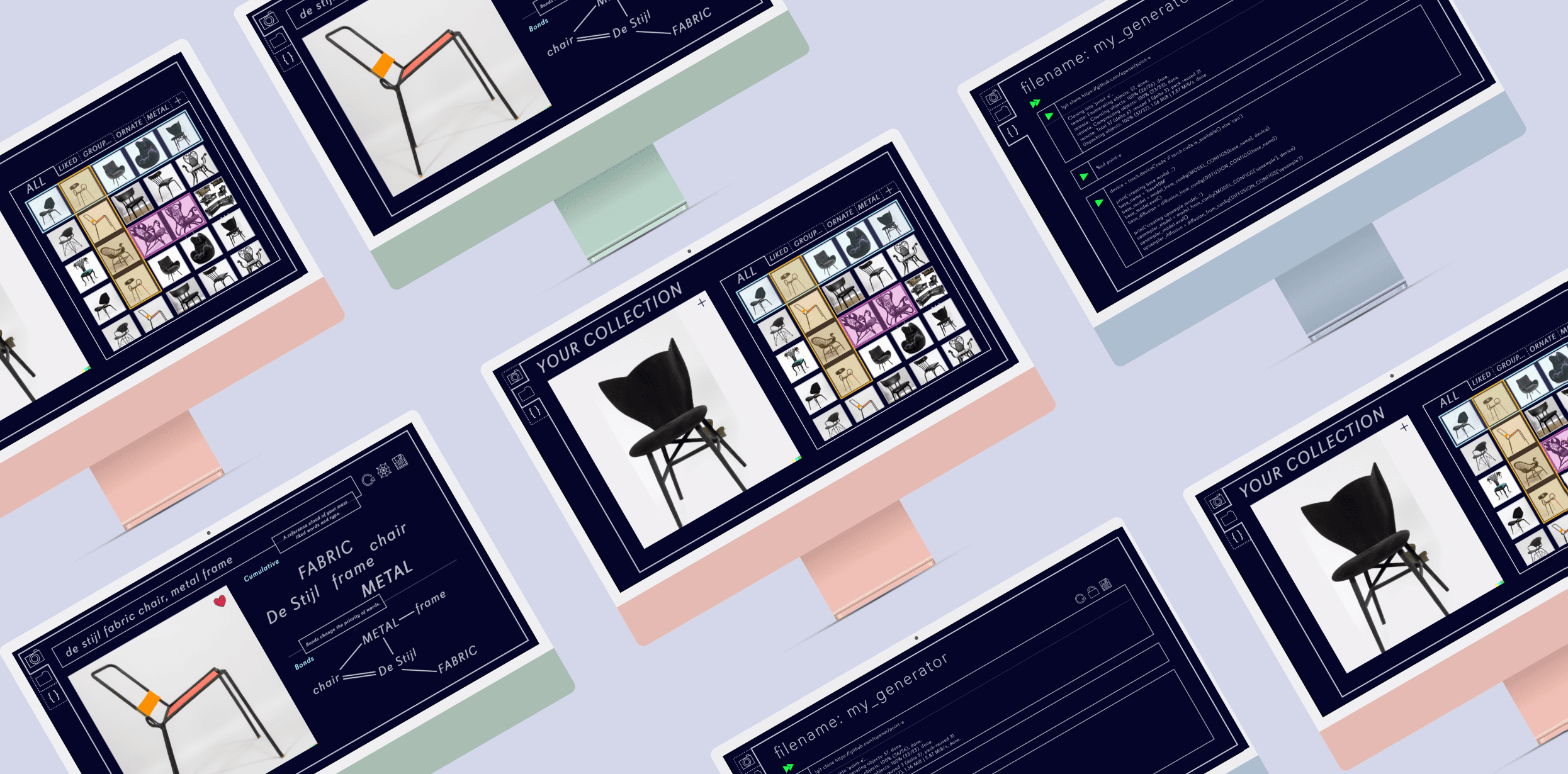
On the main screen of Chemist, you prompt and you're able to reorder your prompt in the secondary window. Based on how molecules chemical composition change wildly depending on the types of bonds between their atoms, this visualizer stresses different parts of the user's text prompt.

I was very inspired by my Chef. It was here I realized that prompting itself is a bit like Chemistry.

My thesis prof was again, skeptical about this method. When I generated 100 riffs on classical mid-century modern furniture pieces, he became a believer. Thus, the chemist UI was born.

On the main screen of Chemist, you prompt and you're able to reorder your prompt in the secondary window. Based on how molecules chemical composition change wildly depending on the types of bonds between their atoms, this visualizer stresses different parts of the user's text prompt.

Visually Organized

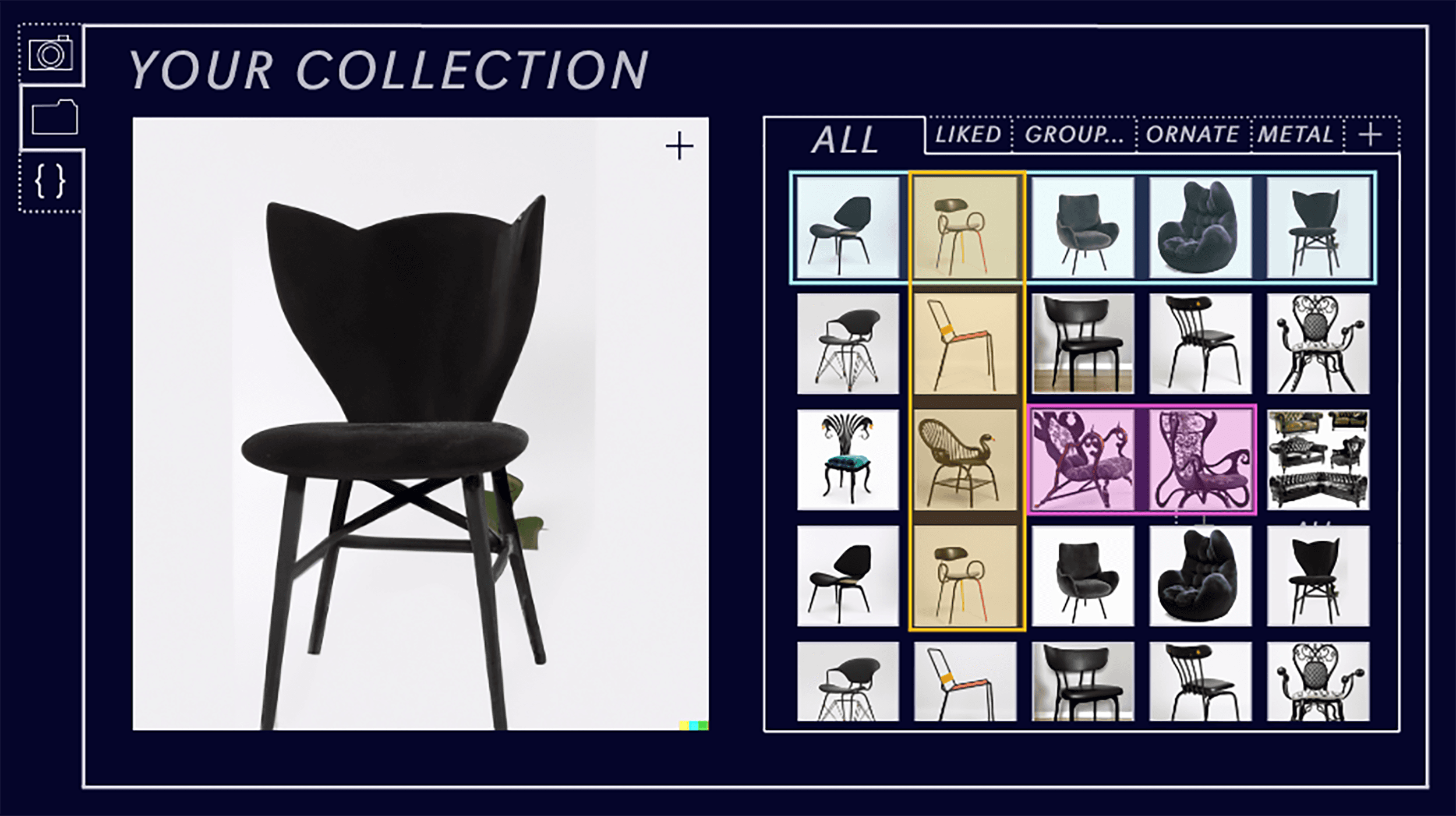
I also wanted a way for designers to see how their habits overlap. This screen allows users to click and drag images into collections, and then study their prompting habits in order to create pieces accurate to their personal aesthetics.

If I were to go back to this project now, as a designer a few years down the career path, I would like to improve this screen.

I also wanted a way for designers to see how their habits overlap. This screen allows users to click and drag images into collections, and then study their prompting habits in order to create pieces accurate to their personal aesthetics.

If I were to go back to this project now, as a designer a few years down the career path, I would like to improve this screen.

The Future is Now!

While working on this project I used Google Co-labs a lot to host my own AI instance of Dall-E 2.

This was in 2023, when creating your own AI agents wasn't even heard of yet. I wanted to work in a screen for all the dev-signers out there to be able to edit their code. I pride myself on being future oriented, and I'm glad to see now with the rise of Claude Code and OpenClaw that more and more folks want to be in full control of their own agents, on their own system.

While working on this project I used Google Co-labs a lot to host my own AI instance of Dall-E 2.

This was in 2023, when creating your own AI agents wasn't even heard of yet. I wanted to work in a screen for all the dev-signers out there to be able to edit their code. I pride myself on being future oriented, and I'm glad to see now with the rise of Claude Code and OpenClaw that more and more folks want to be in full control of their own agents, on their own system.

A Wee Demo

A Wee Demo

A quick look at how Chemist works.

A Surprising Conclusion

A Surprising Conclusion

This project earned the Nora E. Vaughn Best Student Work Medal, and parts of this thesis that did not make it to this "quick look" page on my portfolio have since been folded into OCAD's curriculum.

Looking back I think the core idea - giving users granular control over prompt structure rather than treating prompts as a single opaque string only gets more relevant as prompting itself becomes a design surface for agentic tools, not just image generation. As someone who loves AI, and loves tech, I am excited for the future.

Would you liKe another?

NEXT UP: