Greeen - A Microfinance Goal Setting App
UI/UX Design
Role: Lead Designer
Leminscate
Before you panic - yes I am also a writer.
I can write a LOT. Journaling my progress is integral to my process. I have done my best to abridge my personal notes for you. Enjoy!
Foreword
It’s not hard to imagine that today, people are at odds with inflation. Rising costs of living (more like insane cost of living in Canada) and sky high rents, cause many of us physically cringe when we look at our bank accounts.
I count myself as part of this cadre - I have not been the best with my finances since graduating design school. I’ve had to learn ways to calm myself down when I look at my bank balance, especially after paying rent. My partner is the same way too, always preparing more money for some far off day full of unexpected misfortunes, and possibly, the collapse of civilization as we know it. Our roommate and long time friend is always on edge about anything money related. Notice how I said roommate? At an average thirty years of age between us, we have a roommate in our household. Another money saving trend popular among younger Millennials (us) and late Gen Z.
Times are tough. And like many have said before, “we live in a capitalistic society”. My goal in this project is not to frame our current goings-on as all doom and gloom. We have to leverage capitalism, and find a way as creative people to live within it. My goal is to deliver an experience that helps those who face constant “spending anxiety” breathe a bit and reflect.
What if - we felt good about spending? What if our banking apps told us all the good things we were doing for ourselves?
As usual, I find myself encountering a unique problem to solve in my own daily frustrations.
But first, research!
Good ideas are useless without a need for them. So I found myself thinking about potential users, and potential types of people I would want to interview and poll. My first look at user groups was:
- Canadians feeling squashed by inflation
- Renters
- People struggling with credit debt
- First time bank account openers
- Single Parents
- Impulse buyers
- University students/international students
- People struggling with “financial apathy”
- Elderly, fixed income
- Small/Micro business owners
- Struggling Creatives
- Minimum wage/low wage earners
- People on EI or Disability Benefits etc.
- Veterans
Considering these users, I scrawled down a list of questions I would want to ask in an interview setting. Interviewing is my preferred method of user-research. In my research phase, I managed to acquire a sample size of 30. This was in part thankfully, because I started directing prospective users to a survey link I had put together.
If you would like to take a look at these questions, or participate, check out the link here.
Responses that just “stuck” with me
I did not realize when I started this project how many different perspectives on money I would encounter. We are indeed a people on edge! I take it as a compliment though, that my subjects would feel like they can trust me with these complex emotions.
- The hardest worker in my family growing up was profoundly unhappy. Partially for others reasons (trauma), partially because he placed all of his self-worth in "doing" rather than "being".
- Financiers have intentionally made their terminology difficult to follow.
- No real money management skills were taught to me.
- ...it makes me sick that we as a society cling so desperately to a piece of paper while on the other hand I spend enough time in the rat race to be indoctrinated into the notion that money makes the world turn.
- Understanding things like "investing, how to save a bit more cash, mortgages, or even fancy words like amortization periods" are cookie cutter solutions to a deeply systemic problem of wealth inequality.
- My mother is from the phillippines. So she was pretty free with her money i assume because she didnt have that at home, so here she is in Canada with Canadian dollars and was like I want to buy these things because I never could before.
Clearly, I have a lot to take on here.
Needs Synthesis
I poured over my sample size and began writing down needs that I observed in multiple instances across my interviews and survey responses. I stuck them to the wall on my favourite tool for organizing design thinking – sticky notes!
Finally, visuals!
I was intrigued by my groupings and thoughts on them. In total, I was able to sort all 34 needs under 12 groups. Those groups are:
- Emotional
- Quantitative Needs
- Education
- Spending
- Investing
- Inflation
- “The Bottom Line”
- Anti-Capitalist
- Foresight
- Self-Actualization
- Clarity
- Taxes
There were definitely some heavy overlaps between the education, spending and foresight categories. Similarily, there was overlap between the emotional and anti-capitalist categories.
Challenges
1. The Anti-Capitalist Perspective
It was admittedly hard not to get sucked into the Anti-Capitalist grouping and frame the whole project that way. I wondered when we saw Captialism as a force of good in the world, to challenge any possibility of accidentally stumbling into an echo-chamber. I did a little research on the topic, and ran into this article from Vox.
This article states it wasn’t particularly capitalism that made us happy - that we’re now in a place where advertising and commercialism have managed to co-opt countercultural means to living within this type of society. That they created the idea that obtaining more and more would make us happy. I’m inclined to agree with this, I see where they’re going. But as someone who has also studied medieval art and history, I can confidently say we’ve always wanted stuff. It’s just that stuff in general, has become more accessible. Nobles used to obsess over things that are totally commonplace for us now, such as the colour purple in fabrics or spices.
Has over-abundance and rapid manufacturing confused our priorities? Maybe because things are so easy now, what we’re able to obtain gives us such little satisfaction.
What if we were able to celebrate the little things again?
2. The State of Inflation in Canada
Look, I can only read and parse documents from the banks so much. So instead, I’m going to compare grocery prices over the years. Especially since this is an area all my users struggle with. I decided to take a look at the CPI.
Of course, governments are known for obfuscating figures in order to look good. While our current rate of inflation looks good compared to the 1970s, buying power did not grow in the same way in the leadup from the 70s to the mid 80s.
According to the CPI, a basket of groceries in 1985 would cost weekly, roughly $80. That same basket with the same money is worth $368 now. And of course, we’re all feeling like our food costs that much. In fact, we’re nearly perfectly on par with that. A family of four spends roughly $350 a week on groceries. Our buying power hasn’t increased at all, and the strain from external factors on pricing is far larger than restricting inflation.
How are we supposed to stay calm about food costing a ton while our wages are dead in the water?
Admittedly, I do not have an answer for this. But at the very least, I have some perspective of where my users are coming from.
Addendum
At this point , I felt myself becoming “lost in the sauce” of research.
Being able to go back to my wall and look at these challenges I’m researching and re-organize my thoughts and direction has been so, so helpful. There were other challenges I encountered in addition to what I’ve detailed above. They broached subjects such as Doomscrolling, Self-Worth, and just being able to Educate yourself on financial literacy.
I did take the time to research these, but for the sake of brevity and my portfolio they are not outlined here. If you’re interested, I would love to chat about them!
Personas
When I first came up with the idea for this project, one of the first steps I came up with was writing down and recording a bunch of ideas for potential user groups. Since my interviews and survey experience, I recognize that this is an awesome, very imaginative, list. What I gleaned from my research however, is that there are subtypes of people that are much more subtler than this list lets on. So let’s add a few more:
- New Parents Between Jobs
- Young Couples saving for the future (i.e. house down payment, weddings)
- Established, Yet Disillusioned Professionals
- Soon-to-Be Retirees, anxious about being on a fixed income
- The Compulsive Saver
- Second Generation Poor
- Jaded Economics Grads, who never had a salaried job
Another interesting piece of info of note - nearly all of my participants linked their familial background with their current relationship to money. As someone who wasn’t really taught about finance from their family, and doesn’t feel as though they inherited this, it’s a little fascinating.
Lets move on to my detailed user personas...
Persona 1: Zack Fallidor
Age: 31
New father - has a wife who doesn’t work. Zack is a dedicated, loyal, nerd who loves his family a lot. When he has a little bit of spare cash for himself, he spends some on buying trading cards for his favourite deck building game and tries to save the rest. He’d love to ask his wife to get a job, but has a hard time justifying it because she is greatly attached to their child with special needs.
Zack struggles with his own spending due to impulse buying and ADHD. He hates opening his bank account app because of the bleak reality he feels looking at his bank balances. He wishes he could give his family a better life than what he grew up with, but as a family on a single income these days that is easier said than done.
Nothing in Zack’s banking app reminds him of how well he’s actually doing - by providing a roof over his family’s head, tasty food to eat, and the resources his special needs child requires to live a full life.
In reflecting on Zack’s circumstances - how might we design a financial resource that reminds people of how well they’re actually doing? Something that shows us that while we’re not the billionaires we can’t seem to escape from on our home feeds, we are just as valid (if not more important - our shared experiences are what enriches us as a society, after all.)
Persona 2: Phoebe Angelopolous
Age: 24
The daughter of an immigrant - a first born generation Canadian. A very bright woman, skilled in science and math. Has big dreams of curing celiac disease so everyone can enjoy bread. Lives by the motto “There are no shortcuts to any place worth going”. Is fairly pragmatic when spending on daily necessities, knowing there’s no way around these costs for a healthy and balanced lifestyle.
Despite her degree and high qualifications, Phoebe works a minimum wage job - something many of us early grads have in common these days. Work is long and thankless. The craving of material objects beyond the ability to gain them becomes unforgettable - and retail therapy transforms into an essential of daily life.
When looking at her bank account, Phoebe sighs at the loss of money needed to go towards the everyday. It doesn’t get her down for long though, as she always makes sure to save enough for her rent and bills. But when a day is a little too stressful, or she has a fight with her partner - the call of her credit card is overwhelming.
For someone like Phoebe - how might we design a resource that redirects those huge wants that relieve stress? How can we redirect this temporary urge? Is there a way we can celebrate not acting upon impulse?
Persona 3: Samuel Quirino
Age: 40
Once with big dreams of becoming a musician, Samuel’s life has taken some unexpected detours. But that’s nothing new - Samuel has faced adversity his whole life. Growing up, Samuel had to start working early so he could afford to buy himself a guitar; his parents wouldn’t be able to afford one for him on their modest salaries. The motto in the household regarding labour being “work hard enough and you will get what you want.”
It didn’t take long for Samuel to notice how deeply unhappy working made his father though. The notion of entering the corporate rat race as an adult frightened Samuel, and as such he decided to work towards a career in music. Samuel learned to get by on very little, in order to spend more time concentrating on writing songs or practicing with his band. The more time spent on art, connecting with other creatives, Samuel began to realize just how political and important politics are in the art scene.
It was at this key moment in time, that Samuel’s long time girlfriend told him she was pregnant. And just like that, Samuel had to get a regular 9-5 job to support his new family. The office was an entirely different world than the stage - and yet the struggle of supporting a wife and kids cemented the same anarcho-socialist political stances he gained as a struggling musician.
For Samuel, I wonder - how might we design a banking app that focuses more on personal development and anti-capitalist philosophies? Or, something that at least uses language that explains finance in terms everyone can understand - to get away from the purposeful obfuscation of the financial industry.
How do we make money not feel like money (the stuffiness, the (perceived) uptight vibe of financiers everywhere?)
Persona 4: Billie Chan
Age: 67
Billie and her husband have finally entered their golden years, and are retiring (albeit a little late). After having worked the past forty years, they are both looking forward to downsizing their home and taking it easy. Billie is a bit of a mish mash of constantly frugal, and a shopaholic. On one hand, she absolutely loves spending money on her house, garden, and grandchildren. On the other, she overestimates every dollar she spends so she thinks she is often far worse off than she is.
Billie is worried she’s going to have to drastically change her spending habits, she doesn’t know what fixed-income life will include for her and her husband. Of course, downsizing and giving away some old belongings will help. Billie also wants to make sure she leaves a good future for her children when she eventually passes, as she believes in helping others as much as she is capable.
For Billie, the question is - how can we forecast budgets? Is there a way we can help people take stock of what they have, their assets and otherwise? How can we help retiring couples communicate what their pooled assets are? Is there a benefit to doing this in other living situations?
Prototyping
Finally, what we’re all here for! App development. I kept in mind the values of my needs and personas and started loosely sketching ideas by hand.
I love video games. And I love when people can successfully gamify useful things. So that’s where I started mentally. After sketching I hopped into Figma. Nothing was really set in stone, at this point.
I had this original idea that your home screen would show you how close to your typical spending habits you were staying. Instead of a number, you would see a slider which would be colour coded (red, yellow, green) to how well you were doing. This was in part inspired by TD banks MySpend on their app. Working with all the colours here would prove to be a bit challenging though.
So I started playing with layout.
And then I started fighting with layout.
I love games, but I felt like I was drifting closer and closer to Temu levels of design. Which, considering the one time I have used Temu resulted in a migraine, I was not keen on replicating. The poppy design was fun, but I wanted to shoot for something a bit more chic, sleek and mature considering my users. Finance was already complex for them!
It needed to be simpler.
The most useful thing I have learned over my freelancing gigs is that if you have to really fight with it to look good, it’s not a good idea. So, I settled on a simpler colour palette.
As an overhaul for a bank account, I was happy with this. But fate would have other plans...
Enter the Programmer
I have a friend
I met playing World of Warcraft a decade ago, who just so happens to now be a software engineer in Germany. Through following each other on LinkedIn, we reconnected and talked about making products together. Patryk wanted to practice web design and coding for phones, and I wanted to get the experience of working with a dev. Together we formed Studio Leminscate to you know, have a cool working name.I showed him the concept I designed, I was excited. Patryk said incorporating bank accounts directly into an app would be very complicated and for the moment, not something he was sure he could code. But, he really liked the goal progress screen, and said we should try to focus on this.
So, I ended up scrapping the entire idea and pivoting. It needed to be even simpler. Even more streamlined.
Back to the sketchbook again. What I did know was working for me was the bento box layout.
Greeen - The Microfinance Goal Setting App
The colours? Even more minimal. The concept? Much simpler. Why are there three E’s in the name? Because I like it.
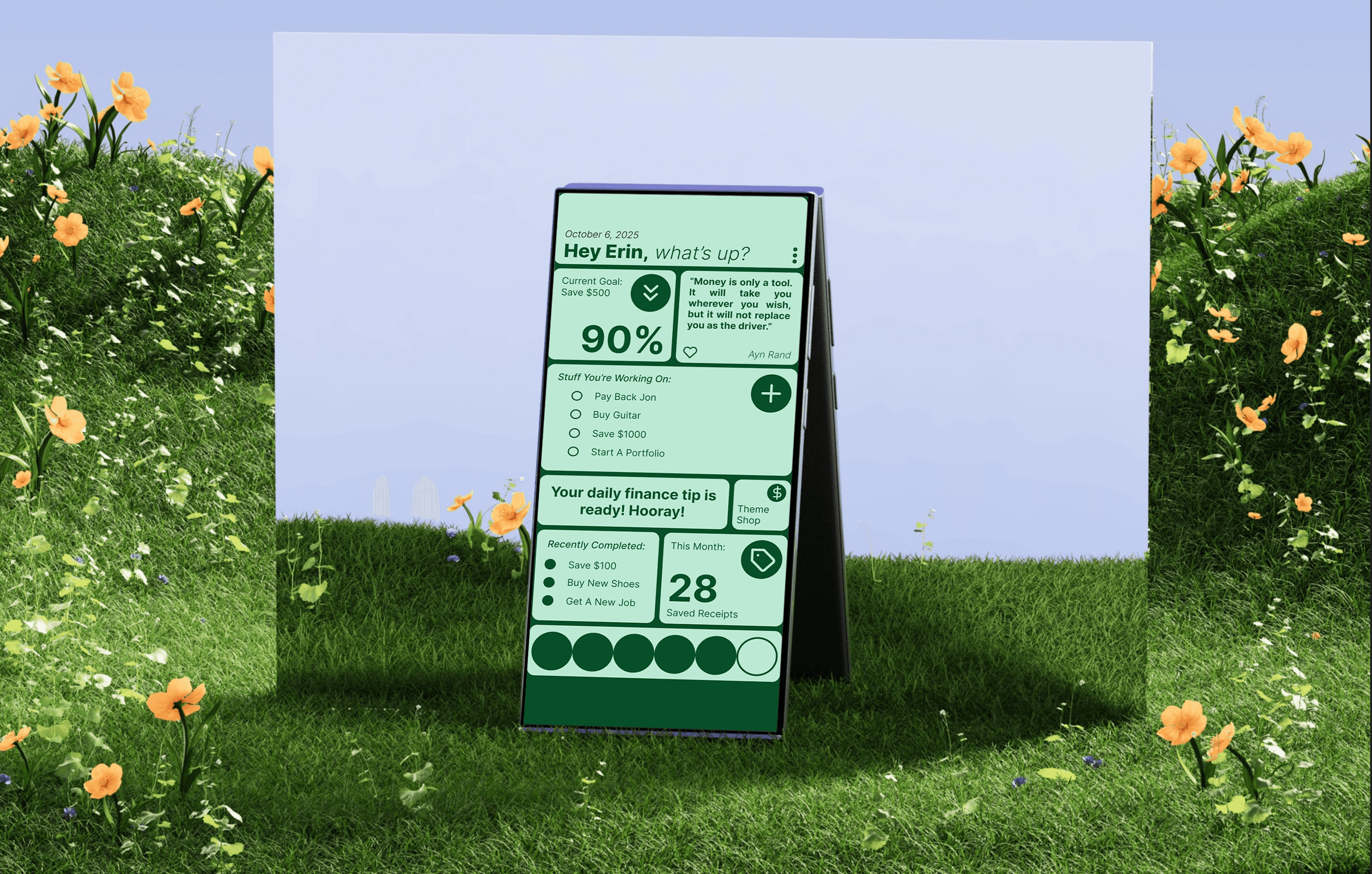
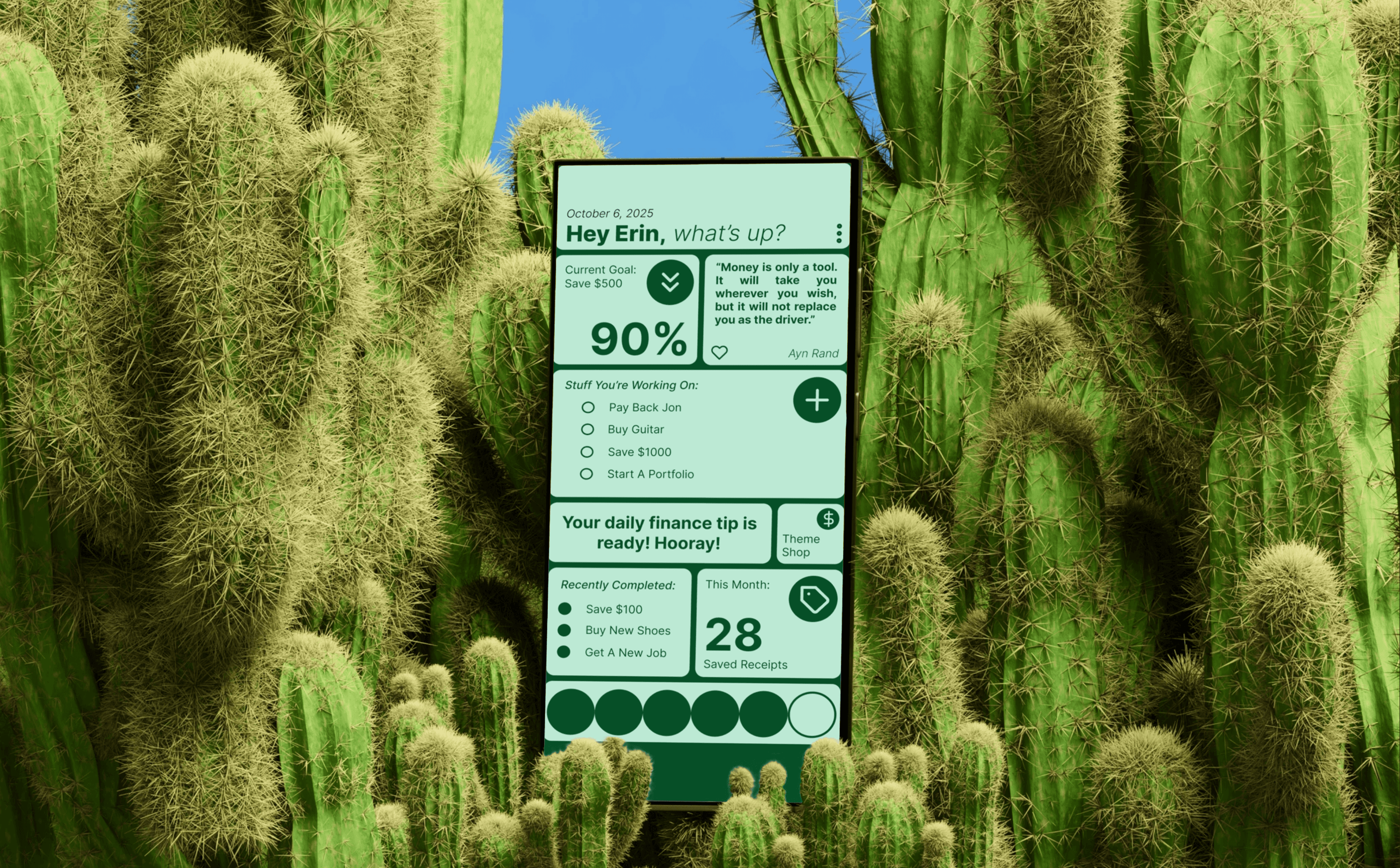
Greeen is a microfinance app because it focuses on what you’re capable of, in the moment. You input your goals, and bank them so you can work your way up to treating yourself. Each goal is worth a token value, which fills out a punch card for a total of fifteen. You can save quotes which appear on the home screen to stay inspired. And the green space on the bottom? That’s for ad space when we monetize our idea - so we can also make a bit of green!
A Work in Progress
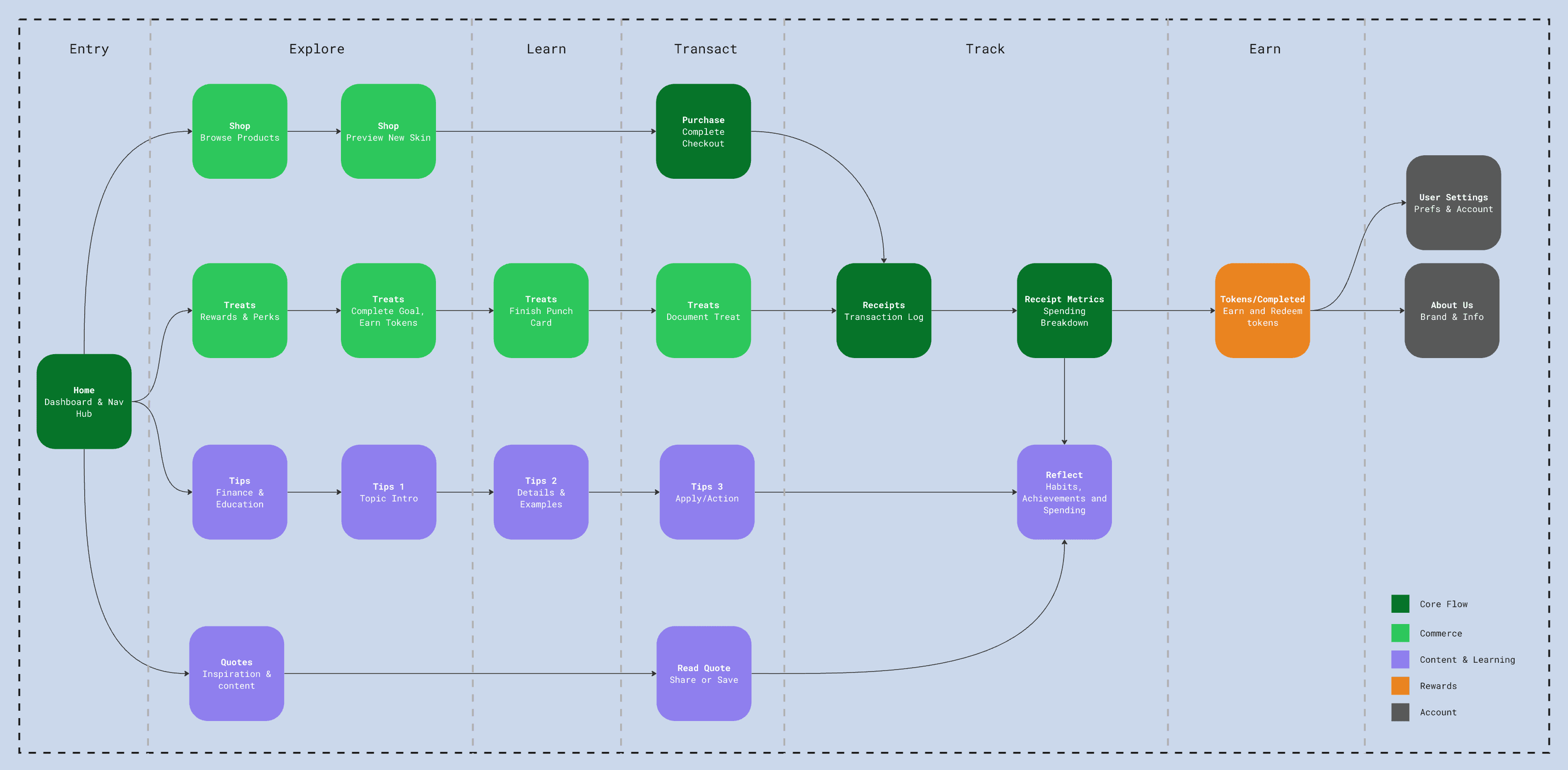
I am still working on this project! Currently, I am also adding a receipt saving screen and finishing up an about us page. I will also be adding a full user journey and app demo video to this page soon.
I hope you have enjoyed following my development of this project!